The best way to describe compostable packaging is a high-wire all-or-nothing balancing act.
That sounds dramatic, but it’s true. It has to be strong enough to function as packaging throughout the supply chain, while also breaking down rapidly into nothing more than carbon dioxide, water and biomass at end-of-life. In other words, it needs to degrade quickly, but only when the consumer needs it to, and not a moment before. And it has to achieve this while looking great, ensuring it stands out on shelf.
Get that balance right, and you end up with the ultimate cradle-to-cradle pack; one that appeals to modern consumer demands and returns to the earth at end-of-life. That’s why, at Parkside, we’re committed to leading the way in compostable innovation, driving the segment forward with new, lightweight compostable films.
Three challenges for compostables
This is difficult enough in rigid packaging applications. But for flexible packaging, where considerations like durability and barrier performance are key, it becomes even more challenging – and the stakes are often much higher.
If the packaging doesn’t break down quickly enough, then it is basically just litter, persisting in the environment and causing all of the same issues as non-compostable, fossil-fuel-based plastics. If it begins to break down too quickly, however, then the results can be catastrophic, leading to consumer anger, safety issues, and expensive product recalls.
The idea of compostable packaging is compelling – but striking this balance in a way that works for both businesses and consumers has proven challenging for many.
Compostable solutions have had to overcome three core challenges not faced by multilayer plastics and monopolymers.
First, performance. Achieving strong barriers against oxygen, moisture, and light – critical for protecting food and other sensitive products – has been difficult without relying on fossil-based materials.
Second, practicality. Many compostable options require industrial composting facilities, which are not always accessible to consumers – or, indeed, local authorities. That disconnect has created a desire for performant home compostable solutions, which can be disposed of in domestic compost heaps.
Third, efficiency. To overcome performance gaps, structures have often become heavier or more complex, undermining both sustainability objectives and cost-effectiveness.
For brands, this has created a persistent dilemma: Meet sustainability targets or maintain packaging performance. Or, more accurately, it had created a dilemma – a dilemma that Parkside is solving.
Choose compostability, not compromise
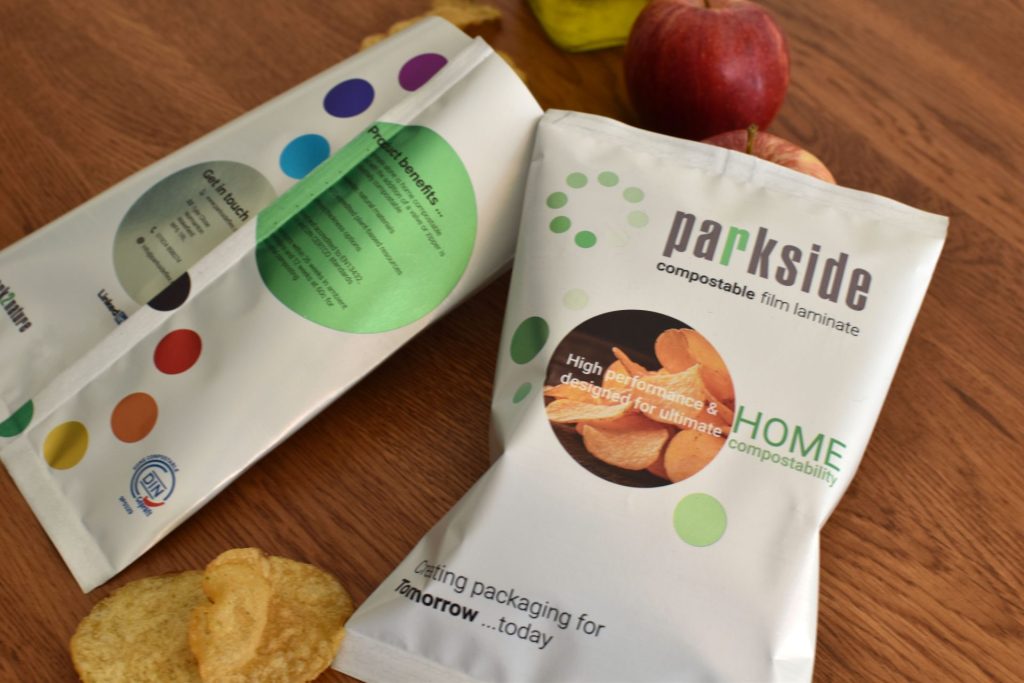
Our next-generation home compostable films are changing the narrative. They offer compostability, not compromises, delivering the functional and aesthetic performance businesses expect alongside end-of-life benefits.
They break down within 26 weeks in a home composting heap, removing reliance on waste management infrastructure and making disposal more accessible for consumers. However, this is also paired with high barrier performance and improved material efficiency, helping to reduce packaging weight and material consumption without sacrificing strength or functionality – and without using fossil-based plastics.
To deliver an enhanced oxygen and moisture barrier for sachets and flow wraps, the HCFD6 and HCFD7 films were engineered to incorporate a single functional barrier layer. This cellulose-based structure also offers light protection, making it ideal for snacks and powders.
In order to meet the demands for nutraceuticals, speciality foods and light-sensitive goods, the HCFT1 was created with a dual metallised structure for a high barrier performance.
Also in the range is the HCFT2, which features a triplex construction. This is best suited for products with a moderate shelf-life, but has strong oxygen and moisture barrier properties, thanks to its combined cellulose with a metallised and bio-polymer layer.
Furthermore, all materials are now accredited for home compostability under DIN CERTCO – a widely recognised European standard for home compostable packaging.
The new gold standard for compostable packaging
This matters not just for us, or for our customers, but for the whole value chain. Brands, consumers, and the environment can all benefit.
For brands, it removes a long-standing barrier to adoption: Performance. Packaging can now meet stringent performance requirements while supporting sustainability commitments, without adding unnecessary complexity or cost. And our new lightweight structures also offer potential savings in transport and material usage, improving overall efficiency.
For consumers, it simplifies the end-of-life journey. Home compostability makes it easier to do the right thing, reducing confusion and increasing the likelihood that packaging is disposed of responsibly.
From an environmental perspective, the benefits are twofold. The materials are designed to return safely to nature, while improved barrier performance helps reduce food waste – a critical, and often overlooked, contributor to environmental impact.
For brands that have been watching from the sidelines, waiting for compostable materials to catch up, this new generation of films represents a turning point.
Finally, compostable packaging no longer means compromise.